Customer Call Experience in Finance: Authenticate Callers Before They Reach an Agent
Improve customer call experience in finance with pre-agent authentication via IVR/AI voice. Cut handle time, reduce fraud, and route callers faster.
Customer Call Experience in Finance: Authenticate Callers Before They Reach an Agent
If your phones handle balance questions, card issues, loan payments, or account updates, your customer call experience is only as good as two things:
1) how fast you get callers to the right place, and 2) how safely you confirm who they are.
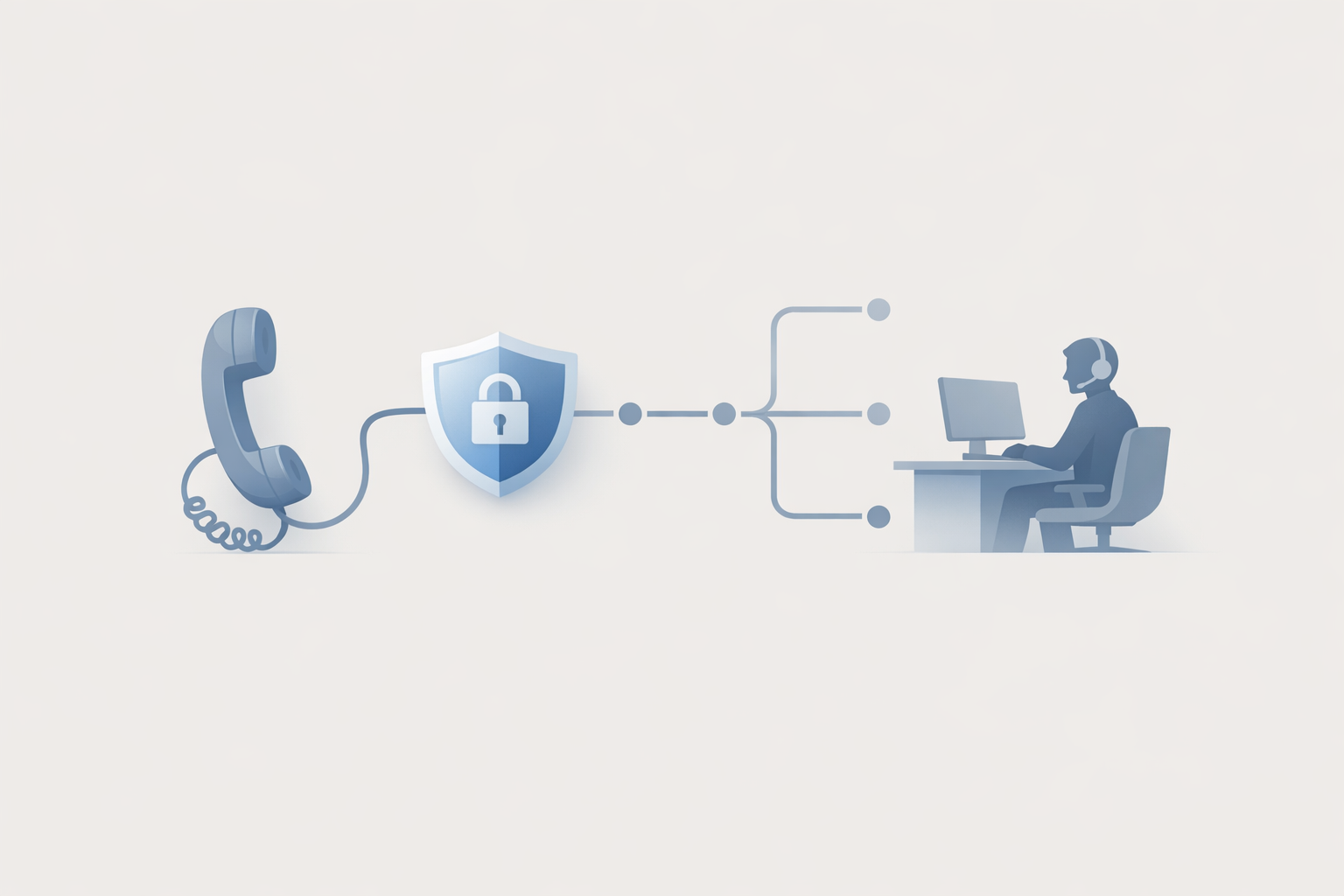
Pre-agent authentication (done well) reduces fraud risk and makes calls shorter—because agents don’t have to re-ask the same basics after the transfer.
Why pre-agent authentication is now part of the customer call experience
The two problems it solves: fraud risk and long handle times
In financial services, every inbound call is a tradeoff between speed and security. If you authenticate too late, you waste agent time and increase exposure. If you authenticate too early (or clumsily), you increase call abandonment.
Use established frameworks to guide your approach:
- The FFIEC highlights layered, risk-based authentication as a core control expectation in financial services (FFIEC authentication guidance).
- NIST provides practical definitions of authentication methods and assurance concepts you can map to call flows (NIST SP 800-63B).
What “good” feels like to callers (speed + clarity + control)
A good experience sounds like:
- “Tell me what you need” (quick intent capture)
- “Now we’ll verify you” (clear reason + short steps)
- “Here’s what happens next” (set expectations)
Where authentication should happen in a finance call flow (and where it shouldn’t)
Before routing vs. after routing (a practical rule of thumb)
Use this rule of thumb:
- Authenticate before routing when the request is high-risk (account changes, transfers, disputes, replacement cards).
- Authenticate after routing when the request is low-risk (hours, branch location, general rates) or when the caller may not have an account.
Don’t collect sensitive data in the wrong place
Avoid designing a flow that tempts callers to speak sensitive data out loud in a public place.
Also: if your flow touches payment card data, align your approach with PCI guidance and your processor’s rules (PCI SSC document library).
Use step-up authentication only when risk is higher
Instead of verifying everyone with the strictest method, use step-up checks when:
- caller requests a risky action
- device/number is new
- multiple failed attempts occur
(Your compliance and risk teams should define thresholds; NIST concepts can help structure this decisioning (NIST SP 800-63B).)
A practical pre-agent authentication menu (IVR scripting template)
Below is an IVR scripting template you can adapt to your business phone system today.
Option A: “Identify me” light verification (low-risk requests)
Use for: general account questions that don’t change customer data.
Script (example):
- “In a few words, tell me what you’re calling about.”
- “If you have an account with us, say or enter your member number. Or say ‘skip’.”
- “Thanks—one moment while I pull up the right options.”
Option B: Account access verification (higher-risk requests)
Use for: password resets, address changes, dispute status, replacement cards.
Script (example):
- “To protect your account, we’ll verify your identity.”
- “Enter your member number.”
- “Now enter the last 4 digits of your SSN (or another approved identifier).”
- “Thanks. If we can’t verify you, we’ll connect you to an agent for help.”
Option C: Lost phone / suspected fraud fast path
Use for: urgent issues where speed matters.
Script (example):
- “If you suspect fraud or need to report a lost card, say ‘fraud’.”
- “For your security, we’ll ask a few quick questions and connect you next.”
How AI voice systems improve outcomes vs. traditional IVR
A traditional IVR is rigid: press menus, repeat prompts, misroutes. A modern AI voice system can improve the experience when it’s designed with guardrails.
Natural language capture reduces misroutes
Instead of forcing “Press 1 for checking,” an AI voice front-end can capture intent like:
- “I need to stop a card payment”
- “My login is locked”
…and route correctly.
Smart routing + context handoff reduces repeats
The goal is not “AI for everything.” The goal is: collect what’s safe to collect, verify appropriately, then pass a clean summary to the agent.
To keep this safe, align your vendor and implementation questions with:
- Your security posture (start here: AI voice security overview)
- Vendor privacy practices (data privacy questions to ask)
Guardrails: what the AI should never do
In finance, your voice automation should not:
- invent policy answers
- guess at account-specific details
- “confirm” identity without approved checks
If you’re exploring AI agents, build guardrails to reduce incorrect statements (see: prevent hallucinations in AI phone agents).
On-hold audio: the overlooked lever that reduces abandonment during verification
Authentication steps can introduce short pauses (system lookups, risk checks, queue handoffs). Those seconds are where callers hang up.
What to say while the system verifies
Use hold-time messaging to:
- explain why verification is happening (“to protect your account”)
- set expectations (“this takes about 15–30 seconds” if true)
- offer next steps (“have your member number ready”)
Smart rotations: keep compliance-friendly messages from getting stale
If callers hear the same line every time, they tune out. Rotating messages let you:
- repeat key security guidance without sounding repetitive
- surface high-value self-service options
- reduce “agent-only” calls over time
OnHoldToGo is built for this: type a script, choose a professional voice and matched background music, and download MP3/WAV—fast (OnHoldToGo). For broader hold strategy, see: on-hold messaging starter guide.
Mini scenario (illustrative): a credit union reduces repeat questions with pre-auth + better hold messaging
Illustrative (not a case study):
Before
- Caller chooses from long menus
- Reaches agent
- Agent re-asks identity details
- Caller is placed on hold again while agent looks up policy/process
After
- AI voice captures intent (“replace card”) and starts verification
- Caller hears a short, reassuring verification message while the system checks
- Agent receives: intent + verification status + the right queue placement
Result: less repetition, fewer misroutes, and a smoother phone hold time experience.
Common mistakes (and quick fixes) in pre-agent authentication
- Mistake: Too many prompts too early.
Fix: capture intent first, then verify only when needed.
- Mistake: One-size-fits-all verification.
Fix: use step-up verification based on risk.
- Mistake: No fallback path for failed verification.
Fix: route to a trained team with a clear script (“We’ll verify you another way”).
- Mistake: Forgetting to tell callers what happens next.
Fix: add one sentence after verification: “Thanks—connecting you now.”
Implementation checklist for SMB finance teams
Policy and compliance alignment
- Confirm what identifiers you’re allowed to collect via voice
- Align with internal controls and guidance references (e.g., FFIEC authentication guidance)
- Review customer-facing communication obligations (see general compliance context: Federal Reserve Consumer Compliance Handbook)
Telephony/IVR build
- Map 6–10 top call reasons
- Define which reasons require pre-agent verification
- Create a “fraud/lost card” fast lane
Audio and scripting
- Write short prompts (one instruction per sentence)
- Record professional on-hold and in-IVR messages
- Rotate messages to reduce caller fatigue
Measurement: what to track
- authentication completion rate
- transfers/misroutes
- repeat callers for the same issue
- call abandonment during verification/hold
Turn verification time into a better customer call experience
Pre-agent authentication doesn’t have to feel like a barrier. With the right flow and the right audio, it can feel like competence.
If you want to upgrade the “waiting moments” around verification and routing, create professional on-hold messages in minutes with OnHoldToGo—or review pricing if you’re ready to implement.