AI Voice System for Franchises: Keep Brand Voice Consistent Across Every Location
Standardize every location’s phone experience with an AI voice system—consistent IVR scripts, on-hold messages, and routing that still supports local details.
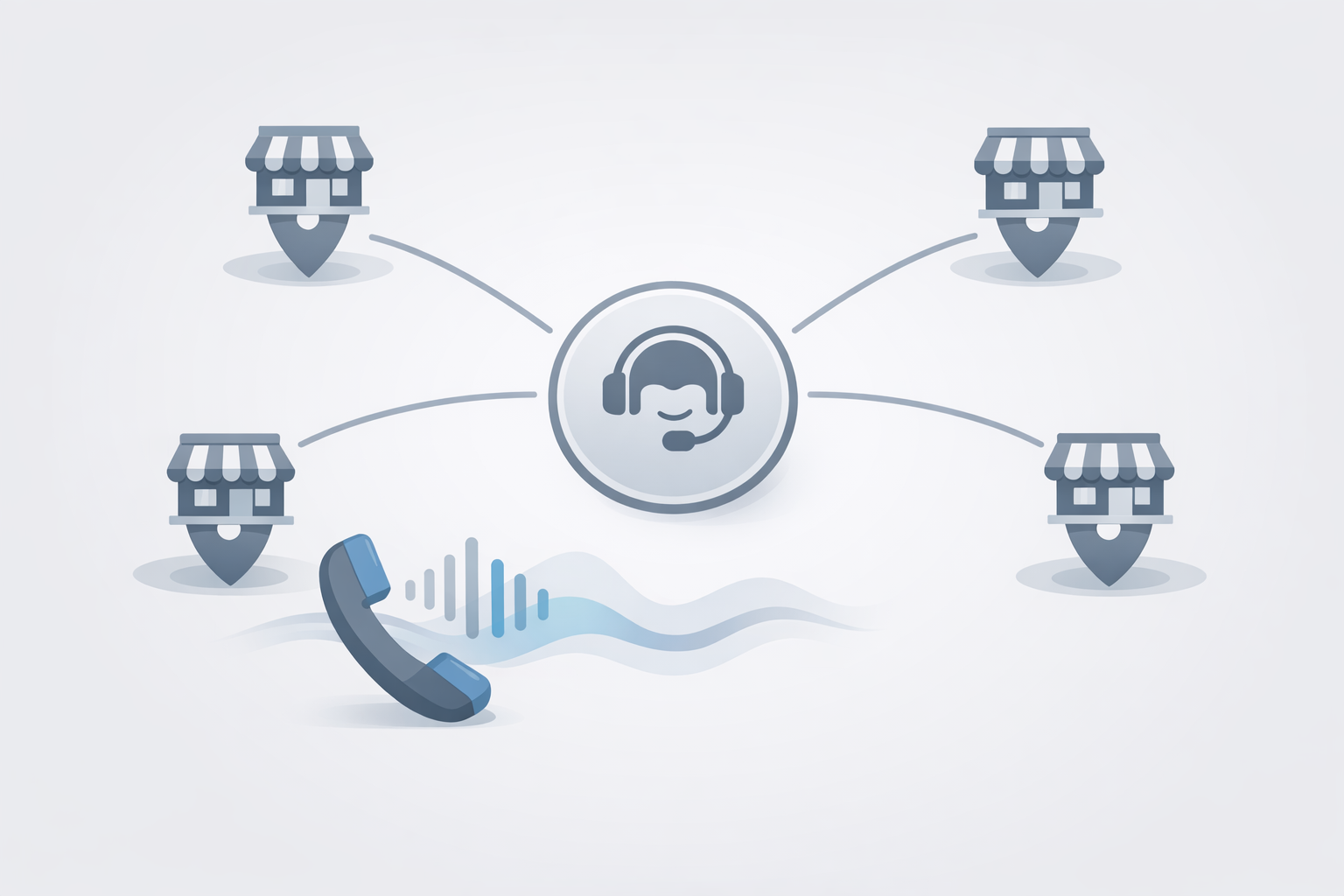
AI Voice System for Franchises: Keep Brand Voice Consistent Across Every Location
When you run multiple locations, your phone experience becomes a “shadow brand.” Customers hear it before they see your website, signage, or storefront.
The problem: even strong franchise brand standards don’t always cover IVR scripting, greetings, and on-hold messaging—so each location improvises. That’s how you end up with 12 versions of “your brand voice,” and none of them are quite right.
This guide shows how to use an AI voice system approach to standardize what callers hear—without stripping away local details like hours, directions, and location-specific offers.
Why franchise phone experiences drift (even when the brand book is solid)
Local “quick fixes” that quietly change your voice
Common causes of drift:
- A manager records a new greeting on their cell phone “just for now.”
- A location adds a new menu option (“Press 4 for billing”) without aligning labels across the network.
- Promotions change, but the phone message never does.
- Different voices (or different levels of professionalism) across locations.
The hidden cost: caller confusion, repeats, and missed bookings
When the phone experience is inconsistent, customers hesitate:
- They’re not sure they reached the right location.
- They repeat information because the IVR prompts differ.
- They hang up when the experience feels unprofessional or slow.
Customer experience expectations are rising across industries, and consistency across touchpoints is a major driver of trust and loyalty (see Zendesk Customer Experience Trends and McKinsey on great customer experience).
What an AI voice system should standardize across every location
Think of an AI voice system as a standardization layer for what callers hear—so every location sounds like the same brand.
Voice + tone: one sound, many locations
Standardize:
- Voice style (warm, direct, premium, clinical, etc.)
- Pacing (clear and unhurried)
- Pronunciation rules (brand name, service names, city names)
If you’re choosing a voice, start here: Beyond elevator music: choosing the right AI voice for your brand.
IVR scripting: consistent options and labels
Standardize:
- The same menu structure across locations (as much as possible)
- The same words for the same outcomes (e.g., always “Book an appointment,” not “Schedule service” in one market and “Appointments” in another)
- A consistent “talk to a person” option
Tone matters here more than most teams realize—especially for first-time callers. See: The impact of voice tone on customer trust.
On-hold messaging: the same promises, the right local details
On-hold messages are where brand voice goes from “nice-to-have” to revenue support.
Standardize:
- Your core proof points (warranty, guarantees, certifications, financing, memberships)
- Your top 3 call drivers (bookings, quotes, status checks)
- Your customer care expectations (what happens next, how long it may take)
Then allow controlled localization:
- Location hours
- Directions/parking
- Local seasonal offers
- Local team highlights (optional)
For a baseline framework, see: On-hold messaging for small businesses: a practical starter guide.
A practical franchise playbook: central control with local flexibility
Step 1: Create a “phone voice guide” (one page)
Include:
- Brand tone (3 adjectives) and what to avoid
- Standard greeting format
- Approved vocabulary list (service names, department names)
- Pronunciation notes
- Compliance notes (no misleading claims; be clear when automation is used)
If your call flow includes automated handling, keep an eye on relevant guidance like the FCC’s telemarketing and robocalls resources.
Step 2: Build a message library (national + local modules)
Create reusable modules:
- National evergreen: brand promise, guarantees, financing, review prompts
- National seasonal: quarterly promos, reminders
- Local evergreen: hours, address cues, service area
- Local seasonal: market-specific promos (approved template)
This also helps with accessibility: clearer, simpler phrasing improves comprehension for more callers (see ADA.gov effective communication).
Step 3: Set rotation rules so callers don’t hear the same thing every time
If callers are repeat customers, repetition kills attention. Your goal is “fresh, familiar, and on-brand.”
Rotation rules:
- Mix evergreen + promo + FAQ-style messages
- Keep each message short (one idea per message)
- Update promos on a schedule (monthly or quarterly)
Step 4: Roll out updates on a schedule (and track exceptions)
Operationally, this is what keeps you consistent:
- One owner for scripts (brand/marketing) + one owner for implementation (ops/IT)
- A simple calendar (quarterly refresh + urgent updates)
- A log of location exceptions (and why they exist)
IVR scripting patterns that protect brand voice (without annoying callers)
Keep the menu short; route faster
Best practice: reduce decisions. If you need 7 options, your routing design is doing too much.
Use consistent verbs and naming
Pick one set of verbs and stick to them:
- “Book an appointment”
- “Get a quote”
- “Check an existing order”
- “Billing”
Then keep those labels identical across locations.
Add an escape hatch to a human
Always provide a clear path to a person (or a callback option) for callers who don’t fit the menu.
If you’re building a voice identity across channels, this complements: Why every small business needs a professional voice identity.
Mini scenario (illustrative): 12-location service franchise
Illustrative example (not a case study):
A 12-location home services franchise has grown quickly. Each location has:
- A different greeting voice
- Different IVR terms ("Appointments" vs. "Scheduling")
- Outdated on-hold promos
Fix: Corporate creates a standardized script pack:
- One approved greeting and IVR script
- Three evergreen on-hold messages (warranty, financing, review request)
- One local insert per location (hours + service area)
- A quarterly promo slot
Result: Every location sounds like the same brand, while local info stays accurate.
Common mistakes franchises make (and how to fix them this week)
Mistake 1: Letting each location write its own scripts
Fix: centralize the base script, then allow controlled local inserts.
Mistake 2: Using hold time as dead air or generic music only
Fix: add 3–6 short messages that answer common questions and promote the next best action (booking, quote, text-back, website).
Mistake 3: Updating promos everywhere except the phone
Fix: add “phone update” as a required step in your campaign checklist.
How OnHoldToGo helps franchises standardize fast
If your goal is “professional, consistent, and easy to roll out,” OnHoldToGo is built for exactly that:
- Create professional on-hold audio in minutes: type a script and generate audio
- Choose from 25 professional voices and add background music matched to your business type
- Smart rotations to keep content fresh for repeat callers
- Download MP3 and WAV (ZIP download available) for easy distribution to locations
You can start from the main site: OnHoldToGo, then check pricing when you’re ready to standardize across multiple locations.
FAQ: franchise brand voice on the phone
How many scripts do we need for multiple locations?
Start with one standardized corporate script pack (greeting + IVR + 3–6 on-hold messages), then add 1–2 local inserts per location.
Can we keep local hours and promos without sounding inconsistent?
Yes—use modular scripting: corporate controls the base voice and wording, locations only fill approved fields (hours, neighborhood, limited-time local offer).
What should we say on hold to reduce hang-ups?
Use short messages that (1) set expectations, (2) answer top FAQs, and (3) give a next step (book, text, website). Keep it helpful, not salesy.
How often should we update on-hold messages?
Quarterly is a practical baseline for most franchises, with “urgent updates” as needed (holiday hours, temporary closures, limited-time promos).